
Storm Damage Lakeville: 7 Signs Your Roof Took a Hit (and 3 Things Storm-Chasers Won’t Tell You)
Here’s the confession no storm-damage roofing outfit wants you reading: most of what they’re going to tell you about your storm-damaged Lakeville roof is designed to sell you a replacement, not to help you understand your situation. That’s not a conspiracy — it’s just how commission-based storm-restoration sales works. If they can’t sell a roof, they don’t eat.
I’m a family-owned local roofer. I still eat if you don’t need a new roof. That’s the whole difference.
So here’s what I’d tell you if you were my neighbor: here are the seven honest signs your roof took a hit in the last storm, and here are three things the friendly clipboard guys standing in your driveway are hoping you don’t know. Read all ten before you sign anything.
The Storm Damage Reality in Lakeville, MN
Lakeville sits in Minnesota’s active hail belt. Between the Dakota County exposure and the flat expanses to the south and west, we see 1–2 significant hail events per year on average and a handful of major wind events. Not every storm leaves damage worth filing on. But some do, and separating those categories fast — before the storm-chasers show up — is the smart play.
The 7 Signs Your Lakeville Roof Took a Hit
1. Soft-metal damage — the smoking gun
Before you ever look at your shingles, look at your gutters, downspouts, air conditioner fins, and vent caps. Hail-sized dents on soft metals are the clearest indicator that hail large enough to damage shingles actually fell on your property. This is what insurance adjusters check first.
2. Shingle bruising
Bruising is a dark spot where the impact knocked the protective granules off, exposing the asphalt underneath. Bruises feel soft when pressed — the shingle’s structural integrity is compromised at that point. Bruising is rarely visible from the ground.
3. Round granule loss patterns
Look in your gutters and downspout catchments for granules. A few is normal aging. A sudden surge of granules after a specific storm — with round loss patterns visible on shingles when someone gets up there — points to hail.
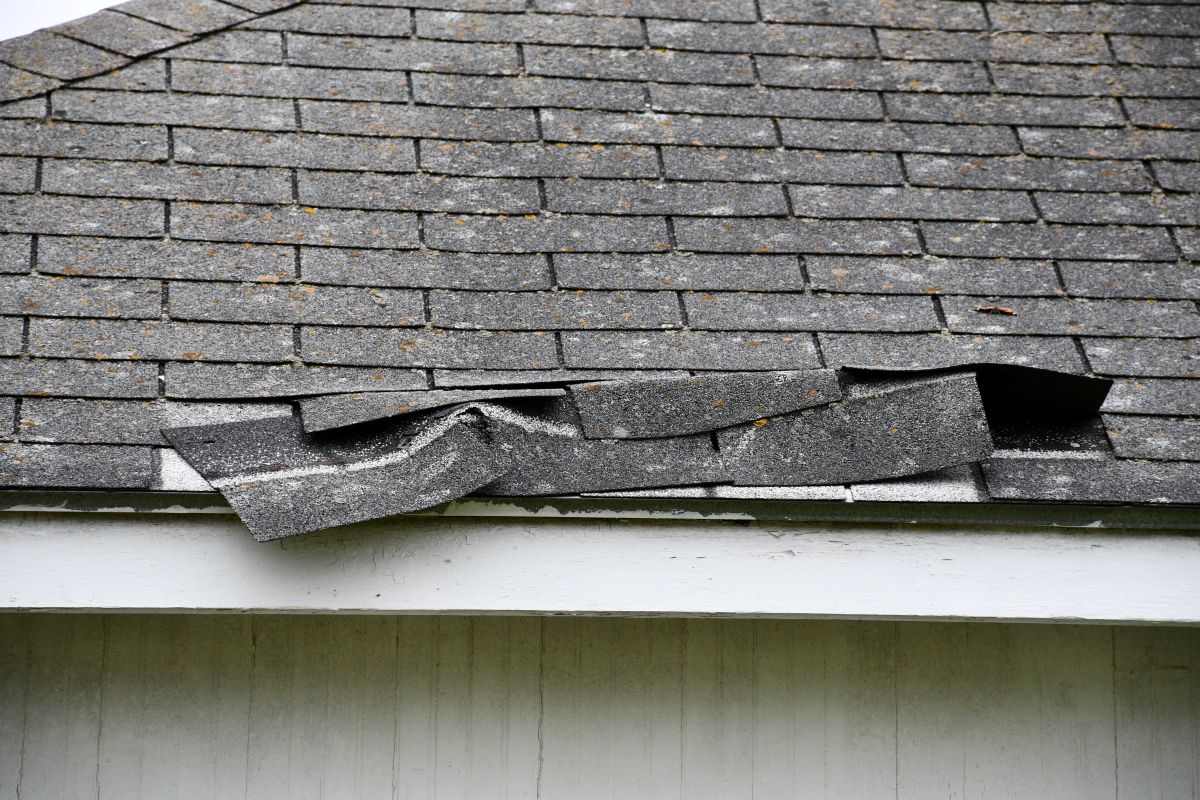
4. Lifted or missing shingles
Wind damage looks different from hail. It concentrates on wind-facing slopes (usually south/west in Lakeville). Shingles are lifted, torn, or completely missing. Sometimes the seal strip is broken even if the shingle is technically still in place — those are more vulnerable to the next wind.
5. Cracked or split shingles
Severe hail cracks shingles outright. You’ll see visible fractures radiating from impact points. Usually clustered in the same areas as bruising.
6. Damaged ridge and hip cap shingles
Ridge caps are the highest point on the roof and take the worst of wind and hail exposure. If your ridge caps are visibly damaged, the field shingles almost certainly took hits too.
7. Interior water staining (delayed)
Storm damage doesn’t always leak immediately. Sometimes seal strips are compromised and shingles peel back weeks later, or a slow leak develops behind flashing. If you see fresh ceiling stains in the weeks after a storm, that’s the storm talking.
Storm Damage Diagnostic — The Ground-Level Version
| Symptom | Visible from ground? | What it likely means |
|---|---|---|
| Dents on gutters, downspouts, AC fins | Yes | Hail large enough to damage roof fell here |
| Missing shingles on wind-facing slopes | Often | Wind damage — check whole slope for lifting |
| Granules piled up in downspout catchment | Yes | Recent granule shedding — probably storm-related |
| Bruising on shingles | No | Requires roof walk or drone inspection |
| Cracked/split shingles | Rarely | Roof walk needed |
| Damaged ridge caps | Sometimes | Especially visible with binoculars |
| Interior ceiling stains | Yes | Storm sometimes shows up here weeks later |
The 3 Things Storm-Chasers Won’t Tell You
Confession #1: Not every hailstorm produces claim-worthy damage.
If the hail was pea-sized and short duration, your roof is very likely fine. Pea to marble sized hail (0.5″–0.75″) causes cosmetic marks on soft metals but usually doesn’t compromise shingle integrity. Penny-sized (1″) starts causing real damage. Quarter-sized (1.5″) almost always does. A storm-chaser will tell you anything looks like damage. A real local roofer will tell you when it isn’t.
Confession #2: Signing an “Assignment of Benefits” gives the contractor control of your claim.
An AOB is a legal document that transfers your insurance benefits to the contractor. In Minnesota, AOBs have caused enough problems that the Minnesota Department of Commerce has begun tightening AOB rules. You do not need to sign an AOB to get storm damage inspected, documented, or repaired. A real contractor will inspect your roof, give you a written report, and let you decide what to do next.
Confession #3: “We’ll eat your deductible” is illegal in Minnesota.
Under Minn. Stat. § 325E.66, a residential roofer cannot pay, waive, absorb, or rebate any part of your insurance deductible. If a roofer offers this, they are either breaking the law or planning to bury the deductible in inflated numbers you’ll eventually pay. Either way, that’s the person you shouldn’t hire.
Wayzata storm just rolled through Lakeville? Get an honest read.
Owl Roofing is family-owned by Tim Brown and Noah Bergland — the kind of Lakeville roofer who picks up the phone, shows up when we say we will, and treats your house like our neighbor’s (because a lot of them are).
Minnesota’s One-Year Storm Claim Deadline
Under Minn. Stat. § 65A.26, most homeowner’s insurance claims must be filed within one year of the date of loss (the storm date, not the discovery date). Don’t wait for interior leaks to appear before investigating — that could easily be after the claim window has closed.
What to Do in the First 72 Hours After a Lakeville Storm
- Stay off the roof. Especially during or immediately after a storm.
- Photograph any visible damage from the ground: gutters, downspouts, siding, windows, screens.
- Note the exact date, time, and hailstone sizes if you saw any (a hailstone next to a coin makes a great documentation photo).
- Get a written inspection from a Minnesota-licensed roofer. Do not sign anything at that inspection.
- If damage is confirmed, file the claim yourself with your carrier. Your roofer will meet the adjuster.
The Owl Roofing Storm Damage Protocol
- Free inspection. Written report, photos, measurements — no signature required.
- We tell you the truth. If the damage isn’t there, we say so. If it is, we document it thoroughly enough that adjusters take it seriously.
- We meet your adjuster. Standard practice, at no extra charge.
- We write supplements. When adjuster scopes come in short, we document what’s missing and push back with evidence.
- We do the work. Manufacturer-spec install, ice & water shield throughout, workmanship warranty in writing.
- We collect final claim payment after work is complete. Per Minnesota law. No games.
Related Reading
- Lakeville storm damage — full service page
- Free Lakeville roof inspection after any storm
- Storm damage roof repair in Lakeville
- Real reviews from Lakeville-area homeowners we’ve helped through claims
- Family-owned Owl Roofing — who we are, why it matters
Lakeville Homeowner Questions
How do I know if a Lakeville storm damaged my roof?
Check the soft metals first — dents on gutters, downspouts, AC condenser fins, and vent caps signal hail large enough to damage shingles. Then look for granules in your gutters, missing or lifted shingles on wind-facing slopes, and damaged ridge caps. Most hail damage isn’t visible from the ground, though — a professional roof walk or drone inspection is often needed to confirm.
How long do I have to file a hail damage claim in Minnesota?
Minn. Stat. § 65A.26 requires most homeowner’s claims to be filed within one year of the date of loss (the storm date). Don’t wait for interior leaks — they can show up months later, sometimes past the claim deadline. If a significant storm hit your Lakeville neighborhood, schedule an inspection within a few weeks.
Should I sign an Assignment of Benefits (AOB) with a roofer?
No — not unless you fully understand the tradeoffs, and probably not even then. An AOB transfers your insurance benefits to the contractor, giving them control of the claim. You can have your roof inspected, documented, and repaired without ever signing an AOB. Minnesota has been tightening AOB rules for exactly this reason.
Is it illegal for a Lakeville roofer to ‘eat my deductible’?
Yes. Under Minn. Stat. § 325E.66, residential roofers cannot pay, waive, absorb, or rebate any portion of your insurance deductible. If a contractor offers this, they’re breaking Minnesota law — walk away. Real contractors don’t need to break the law to earn your business.
What size hail actually damages a Lakeville roof?
Pea-sized (0.5″) hail rarely causes claim-worthy damage. Marble (0.75″) starts causing cosmetic soft-metal damage. Penny-sized (1″) often produces claim-eligible shingle damage. Nickel (1.25″) and quarter (1.5″) almost always do. Golf-ball sized or larger causes severe damage on standard shingles.
Does Owl Roofing handle Lakeville storm damage claims?
Yes — insurance claim work is a core part of what we do. Free inspection with claim-grade documentation, adjuster meetings on site, supplements when scopes are short, and the actual repair or replacement work. Hundreds of Twin Cities claims handled. Call (651) 977-6027.
